


American Education System Explained: K–12, GPA, SAT & College Pathways


What does K–12 mean? What is a GPA? Why do American students call themselves freshmen, sophomores, juniors and seniors? Does every student take the SAT? What are AP courses? Can students attend American high school online? How does homeschooling work? And how is the American education system different from CBSE, ICSE or other Indian systems?
For students, parents and teachers outside the United States, these terms can make the American education system appear complicated.
The reality becomes much easier to understand once we recognise one fundamental fact:
The United States does not have one national school board or one nationally prescribed school curriculum.
Education is primarily a state and local responsibility. States, school districts, schools and other educational authorities play major roles in determining standards, curricula, graduation requirements and school policies. The U.S. Department of Education itself explains that states and communities establish schools, develop curricula and determine many enrollment and graduation requirements.
This complete guide explains the American education system from Kindergarten through Grade 12 and beyond, including high school, GPA, credits, electives, AP courses, the SAT, online learning, homeschooling, financial aid, community colleges and career pathways.
What Is the American Education System?
The structure of education in the United States can broadly be understood through three levels:
Elementary Education → Secondary Education → Postsecondary Education
Students normally begin with elementary or primary education, proceed through middle school or junior high school and high school, and may later enter a college, university, community college, career school or technical institution.
The National Center for Education Statistics describes American education in these three broad levels—elementary, secondary and postsecondary—while also noting that the exact organization of grades varies among school districts.
This variation is important.
A school district may organise Grades 6–8 as middle school, for example, while another may use a somewhat different structure.
Therefore, whenever we describe the American system, we are describing common patterns rather than one compulsory national model.

What Does K–12 Mean in America?
K–12 is one of the most important expressions in American education.
The K stands for Kindergarten, while 12 refers to Grade 12, normally the final year of secondary school.
So:
K–12 = Kindergarten through Grade 12
Students commonly complete Grade 12 around the age of eighteen, although individual ages naturally vary.
A simplified progression looks like this:
Level | Common Grades | Approximate Age Range |
Kindergarten | K | 5–6 |
Elementary School | Grades 1–5 or 1–6 | 6–11/12 |
Middle School | Often Grades 6–8 | 11–14 |
High School | Grades 9–12 | 14–18 |
Postsecondary Education | After Grade 12 | 18+ |
The exact division is not identical throughout the United States.
Is There a National Education Board in the United States?
No.
This is one of the clearest differences between American education and systems familiar to many Indian students.
India has national and state-level examining or educational boards such as CBSE, CISCE and State Boards. The United States has no single equivalent board prescribing the same curriculum and textbooks for every American school.
The U.S. Department of Education specifically states that there are no federal national standards for every academic area and that states create standards while state and local agencies develop curricula.
This means two students in Grade 10 in different American states—or even different school districts—may not necessarily study exactly the same books, courses or sequence of topics.
That does not mean American education lacks standards. It means that responsibility is distributed rather than controlled by one national school board.
What Types of Schools Exist in the United States?
The American educational landscape includes several forms of schooling.
Traditional public schools educate a large proportion of students and operate within state and local public education systems.
Private schools operate independently, although legal and regulatory requirements differ by state.
Charter schools are public schools of choice. They operate under a charter or performance agreement and generally have greater operational flexibility than traditional public schools while remaining publicly accountable.
Families may also choose homeschooling, online schooling or other education models where permitted.
The important point is that regulations for private schools and homeschooling can vary significantly by state. The U.S. Department of Education maintains state-by-state information concerning accreditation, registration, licensing and other requirements affecting private and home schools.
Elementary School in the United States
Elementary school establishes the academic foundations of a child's education.
Students typically develop literacy, numeracy, science knowledge, social understanding and communication skills.
English instruction generally includes reading comprehension, vocabulary, spelling, writing, speaking and language conventions.
During these years, children gradually move from simply learning how to read towards using reading as a tool for learning about the world.
What Is Middle School?
Middle school commonly includes Grades 6–8, although arrangements vary.
At this stage, students begin encountering more specialised subjects and teachers.
English Language Arts becomes increasingly analytical.
A younger student might be asked:
What happened to the main character?
A middle-school learner may instead be asked:
How does the main character's response to the conflict contribute to the theme of the story?
The second question requires students to interpret evidence rather than merely recall events.
This transition becomes even more significant in high school.

What Is American High School?
American high school generally covers Grades 9–12.
These four years prepare students for graduation and for pathways including college, university, community college, career and technical education, training or employment.
American high-school students frequently use four special names for these years.
Grade | Common American Term | Approximate Indian Equivalent |
Grade 9 | Freshman | Class 9 |
Grade 10 | Sophomore | Class 10 |
Grade 11 | Junior | Class 11 |
Grade 12 | Senior | Class 12 |
Therefore, if someone says:
“I am a junior in high school,” the student is normally studying in Grade 11.
The same words—freshman, sophomore, junior and senior—can also be used for years of undergraduate college. Context therefore matters.
What Subjects Do American High School Students Study?
There is no single nationwide subject combination.
However, students commonly complete coursework in areas such as English Language Arts, mathematics, science and social studies, together with other school or state requirements.
American high schools frequently combine required courses with electives.
This can give students greater opportunity to develop individual academic interests.
What Is an Elective?
An elective is a course selected by a student from available choices rather than one required of every student.
Depending on the school, electives may include subjects such as art, music, theatre, journalism, creative writing, computer science, psychology, business, photography or world languages.
Electives do not mean that students can avoid all compulsory subjects.
Graduation requirements still apply.
Instead, electives provide space for students to explore interests alongside required academic study.
What Are High School Credits?
American high-school students normally earn credits by successfully completing courses.
To graduate, students generally need to complete a required combination of credits or courses.
There is no single federal credit requirement for every student in the country because graduation requirements are largely determined at state and local levels.
Students and parents should therefore check the requirements of their particular state, school district and high school.

What Is GPA?
GPA stands for Grade Point Average.
It is a numerical representation of a student's academic performance.
A commonly recognised unweighted model uses the following pattern:
Letter Grade | Typical Grade Point |
A | 4.0 |
B | 3.0 |
C | 2.0 |
D | 1.0 |
F | 0 |
However, this should not be treated as one national formula.
Schools can calculate GPA differently.
Some also use a weighted GPA, giving additional weight to advanced courses such as Honors or AP classes. For this reason, a student's weighted GPA can sometimes be higher than 4.0.
GPA vs Percentage: Can Indian Marks Be Converted Directly?
Students frequently search for questions such as:
“What is 90% in American GPA?”
Unfortunately, there is no universally accurate conversion.
An Indian percentage cannot always be converted directly into an American GPA using one simple mathematical formula.
Schools, universities and credential evaluators may interpret transcripts differently.
For international admission, students should follow the transcript and credential-evaluation instructions of the particular institution to which they are applying rather than relying solely on an unofficial internet conversion table.
What Are Honours Courses?
Some high schools offer Honors courses for students ready for more demanding academic work.
Honors courses may involve greater depth, more complex texts, faster pacing or more challenging assignments.
They are school-based advanced courses and should not automatically be treated as identical to AP courses.
What Are AP Courses?
AP means Advanced Placement.
The Advanced Placement Program allows high-school students to undertake college-level academic study.
College Board currently lists AP courses across English, mathematics, computer science, sciences, history, social sciences, world languages, arts and other areas.
For students of English, two especially important courses are:
AP English Language and Composition
and
AP English Literature and Composition.
AP English Language strongly develops rhetorical reading, argument and nonfiction analysis.
AP English Literature concentrates on literary interpretation, poetry, fiction and drama.
Can Students Take AP Courses Online?
Yes, authorised AP courses can also be offered by online providers.
However, students should verify that a course is officially authorised to use the AP designation.
The College Board's AP Course Ledger provides the official list of authorised AP courses and includes both physical schools and online course providers.
This is much safer than assuming that every online course labelled “AP preparation” is itself an authorised AP course.
How Is English Taught in American High Schools?
English is frequently taught as English Language Arts, commonly abbreviated as ELA.
High-school English normally combines several interrelated areas.
Area | Typical Focus |
Literature | Fiction, drama, poetry and literary interpretation |
Informational Reading | Essays, journalism, speeches and nonfiction |
Writing | Argumentative, informative, narrative and analytical writing |
Vocabulary | Context, word relationships and academic vocabulary |
Language | Grammar, usage, syntax, punctuation and style |
Speaking & Listening | Discussion, presentations and collaborative communication |
Research | Sources, evidence, citation and synthesis |
One major feature is evidence-based interpretation.
Students are expected not merely to state an opinion about a text but to support their interpretation with relevant textual evidence.
Compare these two questions:
What is the theme of the story?
and
How does the writer develop the theme through the protagonist's changing attitude? Support your interpretation with evidence from the text.
The second question requires reading, inference, evidence and explanation.
That movement from identification to analysis is an important characteristic of American-style English Language Arts instruction.
Do American Students Have Board Examinations?
Not in the same way that students sit for CBSE, ISC or other Indian Board examinations.
The United States does not administer one national Grade 10 or Grade 12 board examination that every American student must pass.
Assessment can include classroom tests, essays, projects, research, quizzes, presentations, semester examinations, state assessments and other forms of evaluation.
Requirements differ among states and school systems.
Therefore, a student's academic record may develop across an entire semester or year rather than depend solely on one final board examination.
What Is the SAT?
The SAT is a college-admission test administered by the College Board. SAT (originally called the Scholastic Aptitude Test) is a college admission test administered by the College Board. Today, SAT is the official name and is no longer considered an acronym.
The current SAT has two principal sections:
SAT Section |
Reading and Writing |
Math |
The Reading and Writing section assesses areas including comprehension, vocabulary in context, rhetorical analysis, expression of ideas and Standard English conventions. The Math section covers Algebra, Advanced Math, Problem-Solving and Data Analysis, Geometry and Trigonometry.
The SAT uses multistage adaptive testing. Each section contains two modules, and performance on the first module helps determine the mix of question difficulty presented in the second.
Does Every American Student Have to Take the SAT?
No.
College admission policies vary considerably.
Some institutions may require testing, others may use test-optional policies, and requirements can change.
Students should always check the current official admission policy of each college or university rather than relying on general assumptions about SAT requirements.
What Is the ACT?
The ACT is another college-admission examination used in the United States.
Students considering American universities may encounter requirements or policies concerning the SAT, ACT or test-optional admission.
Again, the correct approach is to check each institution's current official admission requirements.
Online Learning in the American Education System
Online education has become another important area of interest for students and parents.
Online learning can take several forms.
A student may attend a full-time online school, take one or more online courses while enrolled elsewhere, use an online tutoring service, complete supplemental practice or study an advanced subject unavailable locally.
These are not all the same thing.
A learning website used for additional mathematics practice, for example, is not equivalent to a school authorised to issue a recognised high-school diploma.
Parents should therefore distinguish carefully between:
supplemental learning → tutoring → individual online courses → full-time online schooling.
What Are the Best Online Platforms for K–12 Academic Support?
There is no single platform that is automatically best for every child.
The right choice depends on the learner's grade level, subject, learning difficulty, goals and whether the student needs instruction, practice, tutoring or enrichment.
When evaluating an online learning platform, look at curriculum relevance, teacher involvement, quality of explanations, feedback, accessibility, data privacy, age suitability, cost and whether the programme is meant as supplementary learning or formal schooling.
This distinction is particularly important because many popular learning services provide excellent supplementary resources but do not themselves replace an accredited or state-recognised school programme.
How Can Parents Find a Reputable Online High School?
This is an important question because “online high school” can describe very different programmes.
Before enrolling, parents should check the school's legal status, state requirements, graduation requirements, diploma recognition, course-transfer policies and accreditation claims.
Because regulations for private and home education vary by state, the appropriate state department of education should be one of the first places families consult. The U.S. Department of Education provides state-by-state information concerning private and home-school regulations.
Students wanting online AP courses should additionally verify authorised AP offerings through the College Board AP Course Ledger.
How Does Homeschooling Work in the United States?
Homeschooling is legal within a state-regulated framework, but requirements are not identical throughout the country.
Rules concerning notification, subjects, records, teacher qualifications, testing or other requirements can differ considerably.
The U.S. Department of Education makes clear that regulation of home schools is primarily a state and local responsibility and provides a state-by-state regulations resource.
Therefore, families should never assume that homeschooling rules found for one American state automatically apply to another.
What About Charter Schools?
Charter schools are another form of school choice in the United States.
They are public schools, but they generally operate with greater autonomy than traditional district schools in exchange for accountability under a charter or performance agreement.
Enrollment processes and availability vary locally.
Families considering a charter school should consult the charter school itself and the relevant state or local education authority.
Support for Students with Learning Differences and Disabilities
Another important part of the American education system concerns students who require additional educational support.
The Individuals with Disabilities Education Act (IDEA) establishes important protections and educational responsibilities for eligible students with disabilities in public education.
Responsibilities such as identifying and evaluating children who may need special education can also apply in circumstances involving public charter schools and children who are homeschooled or parentally placed in private schools, although specific responsibilities depend on the educational setting and governing rules.
Parents looking for tutoring, assistive technology or online educational support should therefore distinguish between a commercial learning service and services or rights provided under special-education law.
English Language Learners and Bilingual Education
American schools also educate many students who are developing proficiency in English.
Depending on state, district and school policies, programmes may include English-language development, bilingual instruction, dual-language programmes or other forms of language support.
For families, the key questions should be whether a programme addresses the student's language level, provides meaningful access to academic content and fits the requirements of the local educational system.
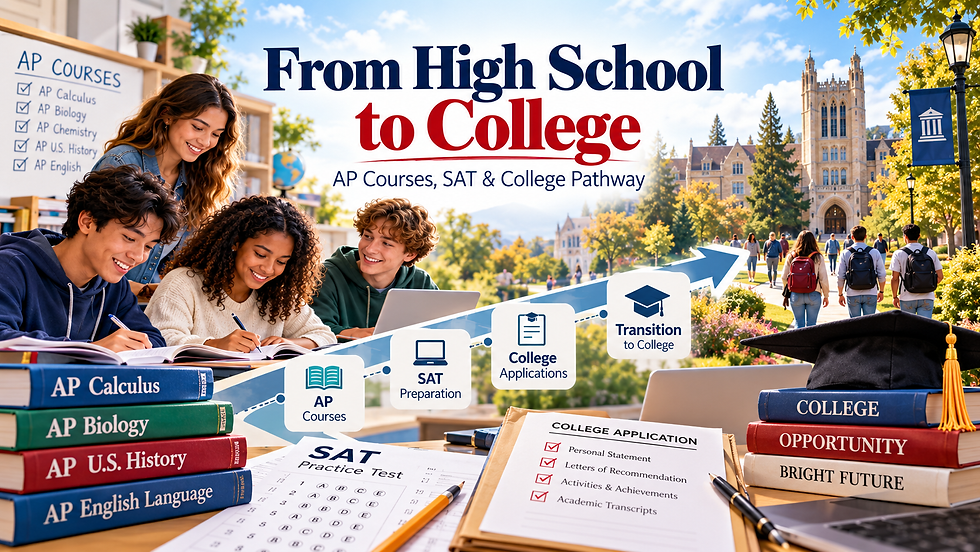
What Happens After American High School?
Students who complete high school have several possible pathways.
The traditional image is:
High School → Four-Year College → Bachelor's Degree
but this is only one option.
Students may also attend a community college, career school, technical programme, apprenticeship or other postsecondary training.
NCES notes that high-school completers may enter technical or vocational institutions, two-year colleges, four-year colleges or universities.
What Is a Community College?
A community college is generally a two-year postsecondary institution.
Students may pursue an associate degree, career or technical education, or coursework designed for possible transfer to a four-year institution.
Community college can therefore serve as both:
a destination for career-oriented education
and
a pathway towards a bachelor's degree.
NCES describes two-year colleges as offering both college-transfer coursework and career or technical programmes.
Career and Technical Education
Not every student needs to follow exactly the same academic route.
Career and Technical Education (CTE) connects academic learning with technical knowledge, employability skills and preparation for occupations or further training.
Career pathways may connect high-school study with certificates, associate degrees, apprenticeships, technical education and later higher education.
Recent U.S. Department of Education material also identifies CTE, work-based learning, pre-apprenticeships and apprenticeships as significant education-to-career pathways.
This makes the American postsecondary landscape much broader than simply “school followed by university.”
College vs University in America
In everyday American English, people often say:
“I am going to college.”
This does not necessarily mean that the institution's official name contains the word 'college'.
The person may actually attend a university.
A university commonly offers undergraduate and graduate programmes and may contain several colleges or schools.
A college may be smaller or more strongly focused on undergraduate study, although institutional structures differ widely.
What Is a Major?
During undergraduate study, students normally select a main academic field known as a major.
For example:
Major: English
means that English is the student's principal area of undergraduate study.
Students may sometimes also complete a minor, representing a smaller secondary field of academic concentration.
Scholarships and Financial Aid in the United States
Financial aid is one of the most frequently researched aspects of American higher education.
Students may encounter grants, scholarships, work-study programmes and loans.
For eligible students seeking U.S. federal student aid, the key application is the Free Application for Federal Student Aid, better known as the FAFSA.
Federal Student Aid explains that completing the FAFSA can provide access to federal grants, work-study and federal student loans. States, schools and some private aid providers may also use FAFSA information when determining eligibility for their programmes.
International students should remember that eligibility rules for U.S. federal student aid are different and should check the requirements that apply to their citizenship or immigration status as well as the financial-aid policies of individual universities.
How Should Students Search for Scholarships?
Students should begin with reliable institutional and government sources.
A scholarship search should always involve checking eligibility criteria, deadlines, academic requirements, financial requirements and whether the scholarship is offered by a legitimate institution.
Students should be cautious about organisations promising guaranteed scholarships or asking for suspicious payments simply to “unlock” awards.
Financial planning is best treated as part of the college-selection process rather than something considered only after admission.
How Do Students Apply to American Colleges?
Admission requirements differ greatly among institutions.
An application may involve an academic transcript, application form, essays or personal statements, recommendations, activity records and, where required or submitted, standardised test scores.
Students should therefore build their application strategy around the requirements of specific institutions, not around one imagined national American admissions formula.
This is particularly important for international applicants.
American Education System vs Indian Education System
The two systems are internally diverse, so comparisons should be treated as broad tendencies rather than absolute rules.
Indian Educational Context | Common American Context |
Classes 1–12 | Grades 1–12 |
Class 9 | Grade 9 / Freshman |
Class 10 | Grade 10 / Sophomore |
Class 11 | Grade 11 / Junior |
Class 12 | Grade 12 / Senior |
CBSE, CISCE and State Boards | No single national school board |
Board-prescribed curriculum often central | Curriculum varies by state/district/school |
Percentage and marks widely used | Letter grades and GPA widely used |
Streams may structure Classes 11–12 | Required courses can be combined with electives |
Board examinations play a major role | No single national Class 10/12 board examination |
Prescribed textbooks are common | Text selections can vary |
Final examinations often highly significant | Coursework, projects, essays, tests and other assessments may contribute |
Subject combinations can be comparatively fixed | Students may have considerable elective choice |
Neither description applies perfectly to every school.
The purpose of comparison is not to decide which education system is “better,” but to help students understand how the two systems are organised differently.
American Education vs Indian Education: Which Is Better?
A meaningful answer depends on what is being compared.
American education often provides flexibility through electives, multiple academic pathways and varied forms of assessment.
Indian boards can provide a highly structured syllabus, clear curricular expectations and common examination frameworks.
Both systems contain excellent schools and programmes as well as significant variations in resources, teaching practices and student experiences.
A more useful question is:
Which features of each system best support a particular learner's goals?
One Important American Approach: Evidence-Based Learning
For English students, one difference is especially valuable.
American-style Language Arts questions frequently move beyond simple identification.
Consider:
Question A: What figure of speech has the poet used?
Now compare:
Question B: How does the poet's imagery contribute to the speaker's changing attitude?
The second question demands:
Technique → Evidence → Interpretation → Effect
This approach develops analytical reading and helps students defend an interpretation rather than merely reproduce a memorised explanation.
Another Important Feature: Student Choice
Many American high schools allow students to combine compulsory subjects with electives and advanced courses.
As students progress, their programmes may become increasingly individualised.
One learner may move towards mathematics and computer science.
Another may combine English, journalism, psychology and theatre.
Another may pursue technical education.
Choice is not unlimited, because students still have graduation requirements.
But the system often gives students significant opportunities to shape part of their academic pathway.
What Should Parents Check Before Choosing an American School or Programme?
Parents should begin by identifying whether they are considering a public school, charter school, private school, homeschool programme, supplementary learning service or full-time online school.
After that, the relevant questions are different.
For a formal school, families should investigate recognition, state requirements, curriculum, graduation requirements, student support and transferability of credits.
For online tutoring or supplemental learning, they should focus on teaching quality, appropriateness for the learner, feedback, safeguarding, privacy, accessibility and educational value.
The distinction between a learning resource and a recognised school programme is extremely important.
Questions Students and Parents Frequently Ask About the American Education System
What does K–12 mean?
K–12 means Kindergarten through Grade 12, covering the principal elementary and secondary school years.
What is Class 9 called in America?
The closest general equivalent is Grade 9, and a Grade 9 high-school student is usually called a freshman.
What is Class 10 called in America?
It corresponds approximately to Grade 10, commonly called the sophomore year.
What is Class 11 called in America?
It corresponds approximately to Grade 11, commonly called the junior year.
What is Class 12 called in America?
It corresponds approximately to Grade 12, commonly called the senior year.
What is GPA?
GPA means Grade Point Average and represents academic performance according to the grading system used by a school or institution.
Is 4.0 always the maximum GPA?
Not necessarily. A 4.0 scale is common for an unweighted GPA, but weighted GPA systems may produce figures above 4.0.
Does America have CBSE?
No. The United States does not have one national school board equivalent to CBSE prescribing a uniform curriculum for the whole country.
Is there one syllabus for every American school?
No. Curriculum and standards involve state and local educational authorities, and school programmes vary.
What is an elective?
An elective is a course students can choose from the options available to them while completing required courses.
What are AP courses?
AP courses are Advanced Placement courses that allow academically prepared high-school students to undertake college-level study.
Can AP courses be taken online?
Yes. Students can locate authorised online AP providers through the College Board's official AP Course Ledger.
How can I find an online high school in the United States?
Start with the appropriate state department of education and verify the school's status, graduation requirements, recognition and accreditation claims before enrolling. State rules vary.
Is homeschooling the same in every American state?
No. Homeschool requirements are regulated mainly at state and local levels and can differ substantially.
Are charter schools private schools?
No. Charter schools are public schools of choice operating under a charter or performance agreement.
Does every American student take the SAT?
No. College testing policies differ between institutions and can change.
What is FAFSA?
FAFSA is the Free Application for Federal Student Aid. Eligible students use it to apply for forms of U.S. federal financial aid and it may also be used by states and schools in their aid processes.
What is a community college?
A community college is generally a two-year institution offering academic, transfer, career and technical programmes.
Can a student move from community college to university?
Yes. Many students complete transferable coursework at a two-year college and later continue at a four-year institution, although transfer policies must always be checked carefully.
Does America have vocational education?
Yes. Career and Technical Education, career schools, technical institutions, apprenticeships and work-based learning provide alternatives and complements to traditional university pathways.
What qualifications are required to become a teacher in America?
Teacher certification requirements are determined largely at the state level, so prospective teachers should check the official education or teacher-licensing authority of the state in which they intend to work.
Why Should Indian Students Understand the American Education System?
Understanding the system is valuable even for students who are not immediately planning to move to the United States.
Terms such as GPA, credits, freshman, sophomore, electives, AP, SAT, major, minor, FAFSA and community college appear constantly in international educational material.
Indian students also increasingly encounter American educational methods through online learning, international examinations, universities, academic websites and digital educational platforms.
Teachers can benefit as well.
American approaches to textual evidence, close reading, argumentative writing, rhetorical analysis, research and student choice can provide useful ideas for enriching classroom practice without simply copying another country's system.
Final Thoughts
The American education system is not one centrally prescribed national curriculum.
It is a diverse educational structure in which states, school districts, schools, colleges and other institutions play important roles.
Students typically progress through elementary school, middle school and high school before choosing among higher education, community college, technical education, career preparation and other pathways.
High school generally includes Grades 9–12, commonly known as the freshman, sophomore, junior and senior years.
Students may encounter GPA, course credits, electives, Honours classes, AP courses, the SAT, online education and multiple routes into postsecondary study.
For international students, the key to understanding American education is therefore not memorising a few unfamiliar terms.
It is recognising the central principle behind the system:
There are common American patterns—but considerable local choice and variation.
Once that principle is understood, terms such as GPA, credits, AP, electives, community college and K–12 become much easier to understand.


Comments