


Mastering ISC Proposal Writing: Your Step-by-Step Guide to Scoring a Perfect 10/10
- PAUL MASIH
- Jan 21
- 5 min read


Mastering ISC Proposal Writing
This comprehensive study material is designed to help ISC Class 11 and 12 students master Proposal Writing, typically appearing as Question 2(ii) in the English Language Paper 1. A proposal is a formal written document outlining a plan or program put forward for institutional approval, usually addressed to the school Principal.
1. Examination Overview
• Total Marks: 10.
• Word Limit: Approximately 150 words.
• Time Allocation: It is recommended to spend no more than 20 minutes on this task.
• Structure Requirement: The Council mandates a five-part structural framework that students must strictly follow.
2. The Five-Part Structural Framework
Component | Sentence/Point Limit | Function |
Title | 1 Line | Contextual orientation based on the prompt. |
Introduction | Max 2 Sentences | Establishing immediate rationale and scope. |
Objectives | Min 2 Points | Defining intended results and educational outcomes. |
List of Measures | Min 4 Points | Detailing the logistical plan (Who, Where, When, How). |
Conclusion | 1 Sentence | Formal request for approval and document closure. |
I. The Title
The title must be apt and clear, extracted or slightly modified from the question rubric.
• Correct: "Proposal for Setting up a Science Club" or "Proposal for Organising a Charity Drive".
• Tip: Avoid cryptic or overly creative titles; clarity is the priority.
II. Heading/Introduction
This section must be concise (maximum 2 sentences). It should define what the proposal is about and the immediate vision behind it.
• Stylistic Tip: Use infinitives to signal intent, such as "To foster an interest..." or "To provide a platform for...".
III. Objectives
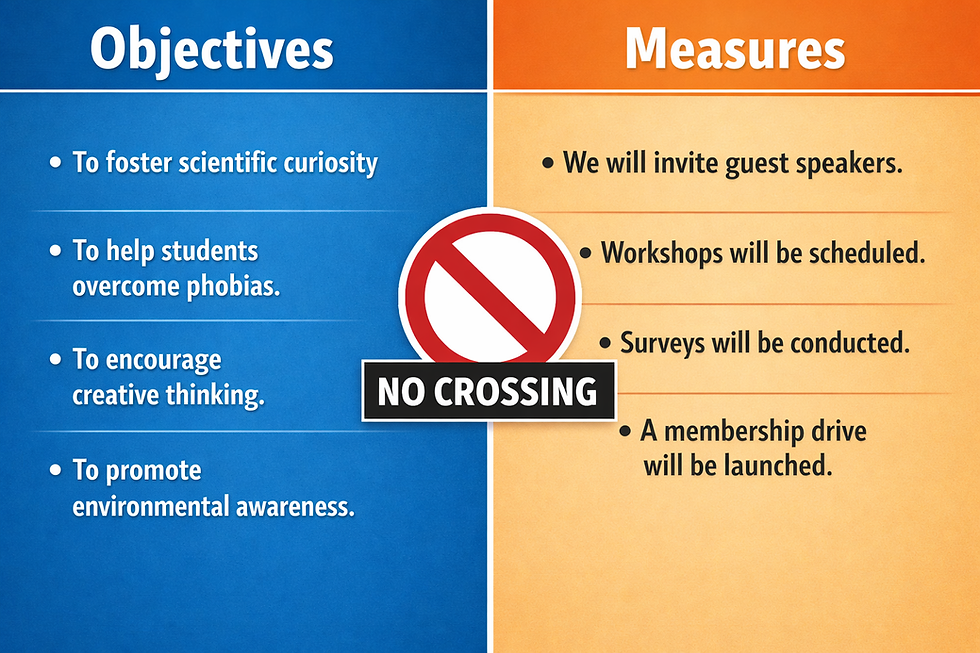
Objectives describe the impact of the project rather than the actions. You must provide at least two distinct points.
• Example (Science Club): "To help students overcome science phobias" and "To develop scientific curiosity through hands-on activities".
• Note: Do not overlap these points with the Introduction.
IV. List of Measures
This is the logistical body of the proposal, worth 4 marks. It must be in bullet points. It should cover:
• Venue: Where will it happen? (e.g., "The middle-school activity room will be used").
• Timing: When? (e.g., "Meetings will take place once a week after school").
• Personnel: Who is in charge? (e.g., "A teacher-in-charge will be appointed").
• Budget/Membership: How much? (e.g., "An annual membership fee of Rs. 250/- will be charged").
V. Conclusion
The conclusion should include a formal one-line statement that requests permission or expresses the hope for approval.
• Example: "We hope that the proposal will be accepted so that the Science Club becomes a reality."
3. Marking Scheme (10 Total Marks)
• Heading/Introduction: 2 Marks.
• Objectives: 2 Marks.
• List of Measures: 4 Marks.
• Conclusion: 1 Mark.
• Linguistic Ability: 1 Mark (Evaluates grammar, formal tone, and appropriateness).
4. Linguistic Guidelines and Tone
• Administrative Maturity: Use formal, polite language. Avoid slang or casual expressions.
• Voice and Tense: Use the passive form and third person. Use verbs like "will," "shall," or "may" to indicate proposed future actions.
• Complete Sentences: Every point, including measures, must be a complete sentence, not just a phrase.
5. Common Pitfalls to Avoid
• Overlap: Repeating the same points in the Introduction and Objectives.
• Vagueness: Using broad statements like "We will do science stuff" instead of specific logistical steps.
• Word Count: Exceeding the 150-word limit can result in penalties.
• Essay Bias: Writing in heavy paragraphs instead of the required point-wise formatting.
• Wrong Format: Using letter-style addresses, signatures, or dates unless specifically instructed by a teacher for school-internal practice.
6. Specimen Proposal: Setting Up a Science Club
PROPOSAL FOR SETTING UP A SCIENCE CLUB
Heading/Introduction: To foster an interest in Science outside the classroom and introduce students to the wonders and relevance of Science in our lives, we propose to set up a Science Club in school.
Objectives:
• A Science Club will help students overcome their phobias regarding Science.
• It will be instrumental in developing the scientific curiosity of students through its activities and programmes.
List of Measures:
• The middle-school activity room will be used as the room for all Science Club meetings and activities.
• The meetings will take place once a week after school from 2:00 p.m. till 3:30 p.m.
• Membership will be open to all students from Classes VI to XII.
• Club membership has been fixed at Rs. 250/- per member per year.
• The Club will host activities ranging from Science Fairs and robot making to creating slogans and documentaries.
We hope that the proposal will be accepted so that the Science Club is established at the earliest.
______________________________________________________________

A standard sample proposal for establishing a Science Club in an ISC school setting follows a specific five-part structure mandated by the Council. This format is designed to present a clear plan of action for institutional approval.
Sample Proposal: Setting Up a Science Club
PROPOSAL FOR SETTING UP A SCIENCE CLUB
Heading/Introduction:
To foster an interest in Science outside the classroom and introduce students to the wonders and relevance of Science in our lives, we propose to set up a Science Club in school. (Maximum 2 sentences).
Objectives:
• A Science Club will help students overcome their phobias regarding Science.
• It will be instrumental in developing the scientific curiosity of students through its activities and programmes.
List of Measures:
• The middle-school activity room will be used as the room for all Science Club meetings and activities.
• The meetings will take place once a week after school from 2:00 p.m. till 3:30 p.m.; any activities such as talks by scientists or competitions will take place on Saturdays.
• Membership will be open to all students from Classes VI to XII.
• The Club President will be Mr. Sinha, our Senior Physics Teacher, and eight other office bearers will be elected from the members.
• Club membership has been fixed at Rs. 250/- per member per year.
• The Club will host a range of activities including Science Fairs, Robot making, creating slogans and posters, and documentaries.
We hope that the proposal will be accepted so that the Science Club becomes a reality in the life of the school.

Key Structural Reminders
• Word Limit: The entire proposal should be approximately 150 words.
• Format: The list of measures must be written in bullet points (minimum four points).
• Tone: Use formal, polite language and preferably the passive form (e.g., "will be used," "has been fixed").
• Marking: In the ISC examination, this task is worth 10 marks, broken down into Introduction (2), Objectives (2), Measures (4), Conclusion (1), and Linguistic Ability (1).


This is an exceptionally clear and exam-oriented guide for ISC students. The step-by-step breakdown of the five-part structure, along with precise mark allocation and common pitfalls, makes proposal writing feel far less intimidating and much more achievable. The emphasis on objectives versus measures, formal tone, and strict word limit aligns perfectly with CISCE expectations and will genuinely help students aim for a full 10/10.
As students progress academically and start planning higher studies—especially overseas—these structured writing skills become invaluable for applications, statements, and formal communication. Alongside academic readiness, practical planning such as housing also plays a major role in a smooth transition abroad. Many international students prefer well-managed options like Student accommodation in Newcastle, which provide affordable, student-friendly living close…
Mastering an ISC proposal starts with clarity and structure. Begin by defining a focused research question and explaining its significance. Review relevant literature to show you understand current knowledge and gaps. Outline clear objectives, methodology, and expected outcomes, and ensure your plan is realistic and well‑justified. Write concisely, use formal academic language, and support claims with evidence. Finally, proofread and revise for coherence, grammar, and formatting. Strong proposals show critical thinking and originality. Internationally, strong research skills are essential — for example, the university of sydney values well‑structured proposals in admissions and research applications.
I learned so much about ISC proposal writing structure and tips. If you’re interested in diverse topics beyond academics, check out Andrea Parker Biography to explore the fascinating career of the American actress known for roles in shows like The Pretender and Pretty Little Liars.
Mastering ISC proposal writing is all about clarity, structure, and smart presentation of ideas. To score a perfect 10/10, start by clearly identifying the problem and proposing a realistic, well-organized solution. Use a formal yet engaging tone, divide your proposal into logical sections, and support your points with relevant examples. Planning before writing is crucial—outline your ideas, decide the flow, and stick to the word limit. Regular practice plays a key role here, and tools like an ielts online mock test can significantly improve your overall writing skills by enhancing coherence, grammar, and time management. Reviewing model answers, understanding evaluation criteria, and learning from feedback will further polish your approach. Focus on precision, avoid unnecessary repetition, and ensure your conclusion reinforces…
Mastering ISC proposal writing is all about combining clarity, structure, and thorough research. To score a perfect 10/10, you need to clearly define your objectives, back up your ideas with credible sources, and present your arguments in a logical, persuasive manner. Attention to detail, proper formatting, and anticipating potential questions from evaluators can make a huge difference in your final score. In a similar way, Sunderland University courses are designed to provide students with a comprehensive learning experience that goes beyond textbooks. These courses emphasize practical skills, critical thinking, and real-world application, ensuring that students are not only academically proficient but also ready to tackle professional challenges confidently. Whether it’s developing strong research abilities, mastering project management, or honing analytical skills,…